Copay vs Coinsurance: What You Will Actually Pay for Treatment

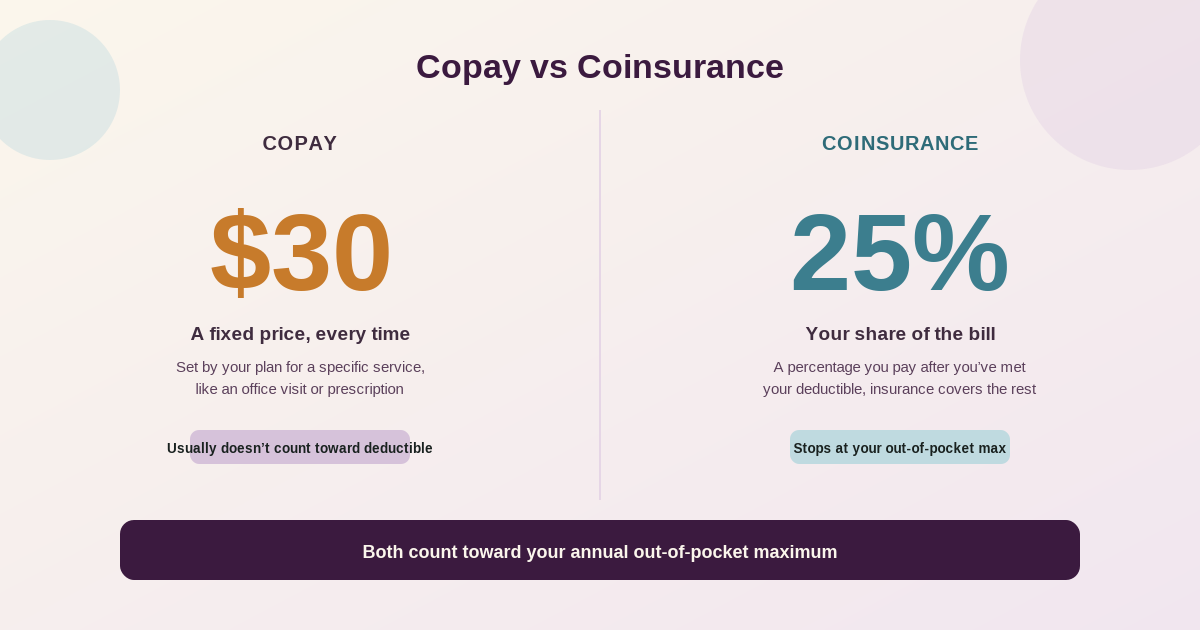
In health insurance, “copay” refers to the set amount you’ll pay for a service, like $30 for an office visit. “Coinsurance” refers to a percentage you pay, for example 25%, usually after you meet your deductible. Each works a little differently, but both contribute to your annual out-of-pocket maximum.
If you or someone you love needs treatment for addiction, the last thing you need is to be stressed about payment definitions. Having a clear understanding of what terms like “copay” and “coinsurance” mean can help you navigate the admissions process more easily and get to care faster. In one focus-group study of people with opioid use disorder, 27 of 28 participants — 96.4% — said a financial barrier had delayed when they started treatment or made it harder to stay in it [1]. Understanding these terms ahead of time is one way to keep that from happening to you.
Don’t worry if you don’t immediately recognize the terminology or understand insurance processes — our admissions team is here to make things simple and walk you through it, however you need.
What Does “Copay” Mean?
“Copay” is short for copayment, a fixed price for a specific service you receive while in addiction treatment. These can include the price of medication prescriptions or accommodation if you’re in a residential program. Your insurance plan sets the amount, and the plan pays the rest of the allowed cost. Residential and inpatient care is more often billed through your deductible and coinsurance, though some plans use a per-day or per-admission copay instead. Costs depend on your specific plan and whether the facility is in- or out-of-network.
Copayments typically don’t count toward your deductible. Your deductible is the amount you pay for certain covered services before your plan starts sharing those costs. Some services, like office visits or prescriptions, may carry a copay and be covered before you meet your deductible. Others, like inpatient or residential care, are often billed against your deductible first.
One of the biggest benefits of a copay is that you have a consistent, upfront price for routine services, which makes financial planning more predictable.
Confused about your coverage?
We verify your benefits for free, with no pressure to commit.
What Does “Coinsurance” Mean?
Coinsurance is the percentage you pay for addiction treatment once you’ve reached your deductible. Your health insurance pays part of the cost, and you pay the rest. The percentage stays the same regardless of the specific service and is often written as a ratio in your policy — for example, 75/25 means your insurance provider pays 75% of the cost and you pay the remaining 25%.
Because coinsurance only takes effect once you’ve met your deductible, it can’t contribute toward it. Coinsurance also stops once you hit your out-of-pocket maximum, the most you pay out of your own money for covered services before your insurance pays 100% for the rest of the plan year. This matters for detox and residential care, where costs can reach that cap.
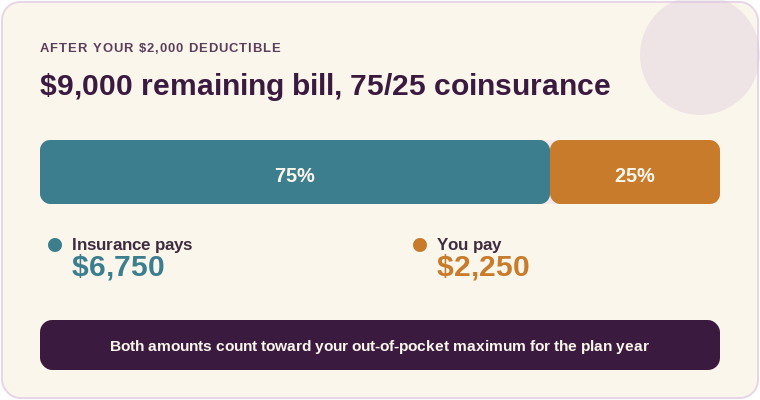
Here’s how that plays out: say you’ve already met your $2,000 deductible, and your remaining addiction treatment costs $9,000. With 75/25 coinsurance, your provider pays $6,750 (75% of $9,000) and you pay $2,250 (25% of $9,000).
Do Copay and Coinsurance Count as Paying Out-of-Pocket?
Yes — both copayments and coinsurance are out-of-pocket payments, meaning they come from your own money, not your insurance provider’s. It’s important to note that both copay and coinsurance count toward your out-of-pocket maximum.
For example, if your out-of-pocket maximum is $10,000 and your share of costs would have otherwise been $11,500, you pay $10,000 and your plan covers the remaining $1,500. Premiums, out-of-network care in some plans, and services your plan doesn’t cover usually don’t count toward that maximum.
Do All Insurance Providers Offer Copay and Coinsurance?
No — health insurance providers aren’t obligated to offer copay and coinsurance as part of their coverage. Many policies do integrate them, but it’s best to check with your provider before you seek addiction treatment.
It’s also worth checking whether the addiction center and program you want to join is “in-network” with your insurance provider, meaning they have a contract and pre-negotiated rates — or “out-of-network,” which can still be well covered under many PPO plans, just at a different rate or through a different approval process. Learn how in-network and out-of-network coverage works before you commit to a program.
How to Avoid Surprise Costs in Addiction Treatment
According to the National Center for Drug Abuse Statistics, the average cost of drug rehabilitation per person is $13,475. A 7-day detox stay can run from $1,750, and an Intensive Outpatient Program (IOP) has averaged around $4,939 in 2022 dollars [2]. Keep in mind these are just reference points, not what you’ll necessarily pay — to keep your own treatment costs as transparent as possible, follow these steps:
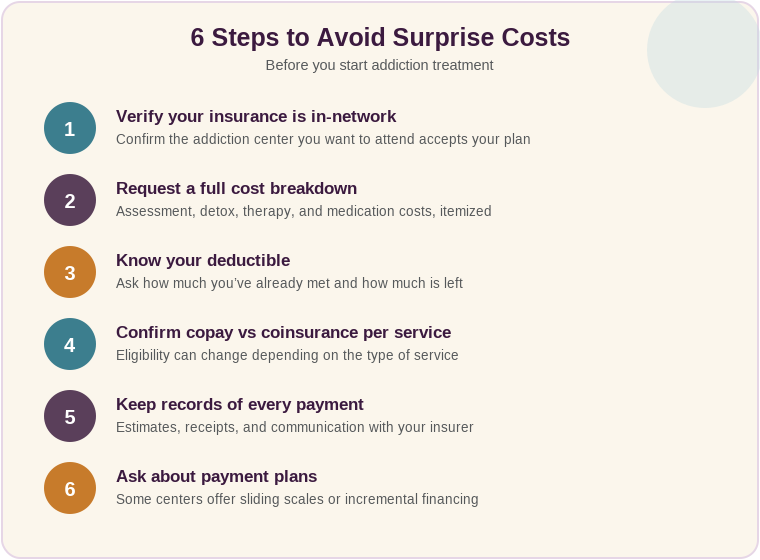
- Verify insurance before starting treatment. Check that your insurance provider is in- or out-of-network at the addiction center you want to attend, then contact the center to verify your benefits and get a rundown of costs for the services you need.
- Request a breakdown of costs. Credible treatment centers will happily give you this information, including the cost of the initial assessment, medical detox, therapy sessions, and medication. Resistance or withholding is a red flag that the center isn’t trustworthy.
- Know your deductible. Contact your insurance provider and confirm your deductible amount, how much you’ve already spent, and whether the percentage you pay for treatment changes if you haven’t met it yet.
- Check whether copay or coinsurance applies to specific services. Eligibility can change depending on the type of service, so confirm with your insurance provider for the particular services you want to receive.
- Keep records of payments. Save estimates, payment receipts, and communication with your insurance provider and the addiction center — useful if there are any discrepancies or unexpected costs.
- Ask about payment plans and financial support. Some treatment centers may offer sliding scales or alternative financing, such as incremental payments, to support people seeking addiction care.
Insurance-Supported Addiction Treatment at Regain Hope Detox, Burbank, CA
We’re a physician-led detox and residential center helping people overcome addiction and co-occurring mental health conditions one day at a time. Our medically supervised program supports you as you find stability and begin your recovery journey, and our residential program gives you intensive care as you prepare to return to daily life after detox.
Our programs include daily visits from a physician and evidence-based therapies such as cognitive behavioral therapy (CBT), along with home-cooked meals. We work with most major PPO insurance plans as an out-of-network provider, including Aetna, Anthem, Blue Cross Blue Shield, Cigna, TRICARE, and UnitedHealthcare. To find out exactly what your plan covers, verify your insurance with our admissions team for free and without pressure to commit.
We serve individuals and couples, and our care is available in English, Spanish, and Korean.
Hope is within reach. Regain yours today — contact our admissions team.
Dr. Mileidys Gomez Gonzalez is a physician specializing in addiction medicine and medical detoxification. She serves as Medical Director of Regain Hope Detox and Recovery Center in Burbank, California.
This article is intended for educational purposes only and should not replace personalized medical or financial advice from your own insurance provider. If you believe you or someone else is experiencing a medical emergency, call 911 immediately.
Sources
- Anyanwu, P. et al. (2024). Understanding the financial barriers to treatment among individuals with opioid use disorder: a focus group study. Harm Reduction Journal.
- National Center for Drug Abuse Statistics. (2025). Average Cost of Drug Rehab. drugabusestatistics.org.