Alcohol Blackout: What Is It and Why Does It Happen?

You may have heard people talk about a night out where they drank a lot and "blacked out." In everyday conversations about partying or celebrating, it's not something you'd necessarily ask people to clarify: "What do you mean, you blacked out?" But the reality is that blacking out can signal a problematic relationship with alcohol, as well as pose serious health risks.
Waking up after a night of drinking and realizing you cannot remember hours of what happened can be frightening. Many people dismiss alcohol blackouts as "just drinking too much," but they are actually a sign that alcohol temporarily disrupted your brain's ability to form new memories. While a single blackout does not necessarily mean someone has alcohol use disorder, repeated blackouts are a warning sign that should never be ignored.
In this article, I'll explain what an alcohol blackout is and what happens in the brain and body when it takes place.
What Is An Alcohol-Induced Blackout?
An alcohol blackout is when someone cannot remember events that happened while they were intoxicated. Blackouts occur when a person drinks enough alcohol to raise their blood alcohol level quickly, and they can last for minutes or hours. A person typically doesn't realize they've had a blackout until the next day, when they try to recall the night, or when others describe events back to them.
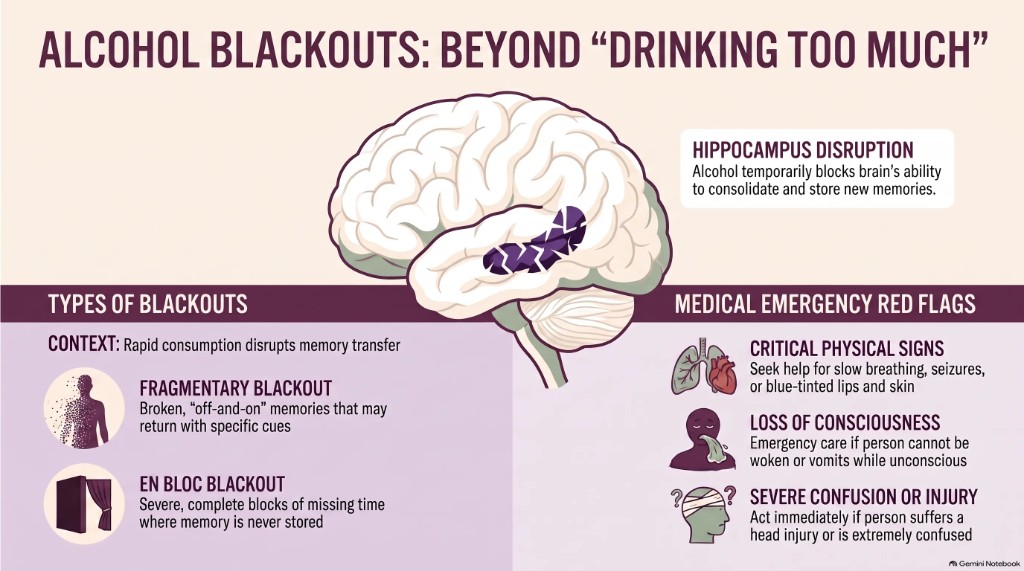
There are two types of blackouts: fragmentary and en bloc (complete). A fragmentary blackout involves broken or "off-and-on" memories — the person can remember some things but not completely or in order, and cues from others often help bring pieces back. An en bloc blackout is more severe and involves dense memory loss for a period of time — a block of the drinking episode is simply missing [1].
A blackout is not the same as passing out, where a person falls asleep or loses consciousness from consuming too much alcohol. During a blackout, a person is awake and may seem to function normally — talking or even walking — but their brain isn't storing new memories.
When Is a Blackout a Medical Emergency?
Blackouts themselves generally don't require medical intervention. However, seek emergency medical attention immediately if the person:
- Cannot be woken up
- Has slow or irregular breathing
- Vomits while unconscious
- Has seizures
- Has blue lips or skin
- Suffers a serious head injury
- Becomes extremely confused or difficult to arouse
Concerned about alcohol use?
Two physicians on-site daily. We verify your insurance for free.
What Causes a Blackout?
When a person drinks to the point of intoxication, alcohol can temporarily block the transfer of memories from short-term to long-term storage — a process called memory consolidation that depends heavily on a brain region called the hippocampus. This can happen even while the person is still able to talk, walk, and carry out other familiar tasks.
Research also shows that specific brain regions are especially vulnerable to alcohol. In adolescents and young adults, whose brains are still developing, repeated heavy drinking and blackouts have been associated with changes in brain regions involved in memory. Because the young brain is still maturing, it may be particularly sensitive to these effects [2] [3].
Who Is Susceptible to Blackouts?
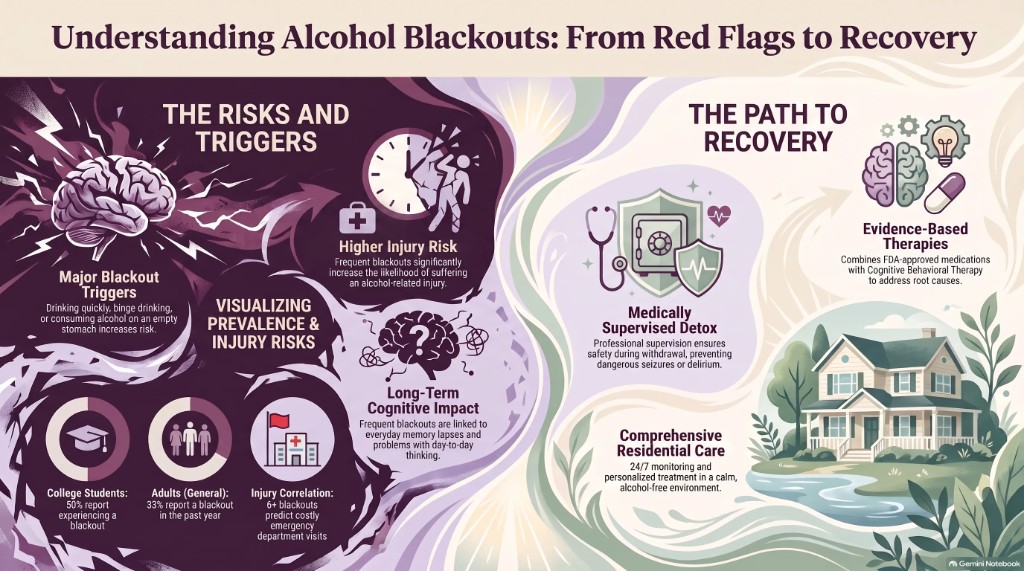
Anyone can experience a blackout when drinking alcohol. Around one third of adults who drink report a blackout in the past year, and roughly half of college students who drink have experienced one [4].
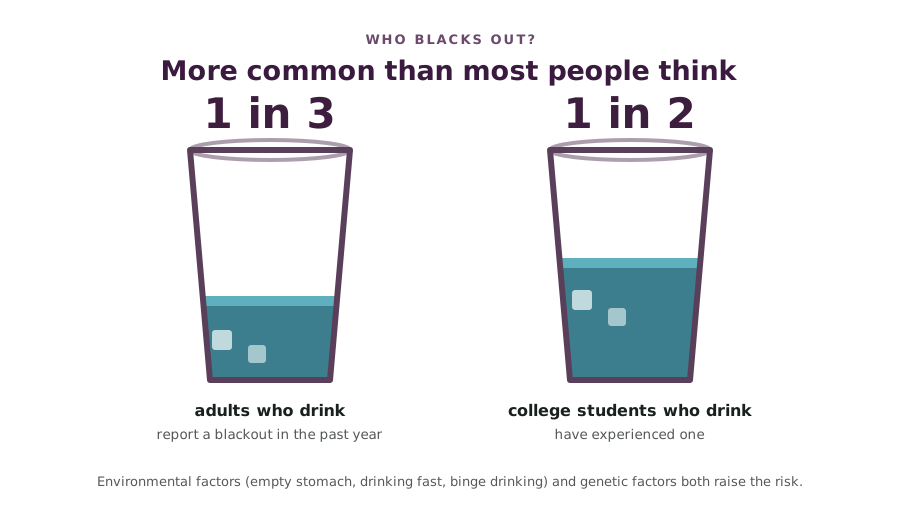
Both environmental and genetic factors can raise the likelihood of a blackout.
Environmental factors include:
- Drinking on an empty stomach
- Drinking quickly
- Binge drinking (a rapid rise in blood alcohol is the biggest driver)
- Drinking while taking certain medications
- Having experienced blackouts before
Genetic and biological factors include:
- Having parents who experience blackouts
- A family history of addiction
- Genes that change how the body metabolizes alcohol
- Individual sensitivity of the brain and hippocampus to high blood alcohol levels
Women are, on average, more likely to have blackouts than men. This is partly because women tend to weigh less and have less water in their bodies, so they reach a higher peak blood alcohol concentration faster for the same amount of alcohol. Female sex appears to raise blackout risk even after accounting for how much is consumed [5].
What Are the Risks of Blacking Out?
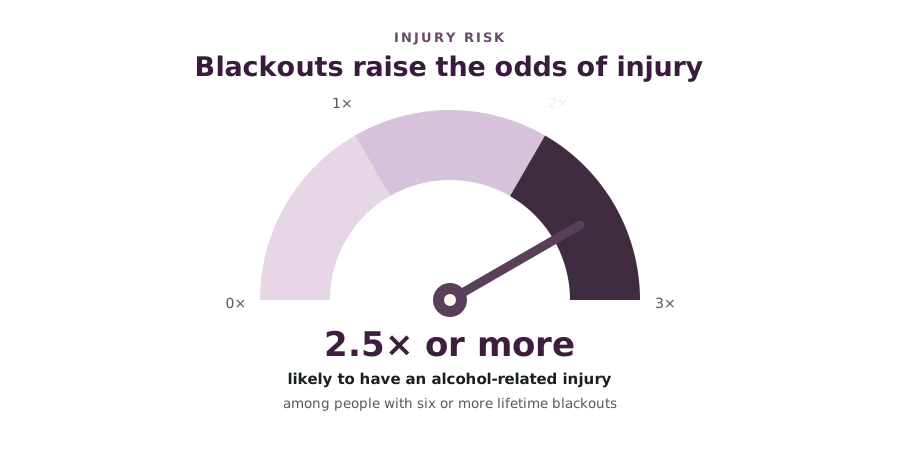
Blacking out carries several risks. The most immediate is injury: people who have had six or more blackouts are more than 2.5 times as likely to experience an alcohol-related injury, and blackouts predict costly emergency department visits [6].
Blackouts are also associated with poor decision-making and dangerous behavior, such as driving while intoxicated, and the resulting memory gaps can strain relationships.
Longer-term risks are present as well. Frequent blackouts have been linked to more everyday memory lapses and problems with day-to-day thinking [7]. Blackouts have also been associated with depressive symptoms and with suicidal thoughts and behavior — though much of this link appears to run through other alcohol-related consequences and heavy drinking overall, rather than being caused directly by the blackout itself [8] [9]. Either way, they are a meaningful red flag.
Treatment for Alcohol Problems
Having blackouts doesn't automatically mean a person has an alcohol use disorder (AUD), but it can be a sign that something isn't right. AUD can develop slowly and quietly — often starting with small justifications for drinking and easy dismissal of how serious blackouts can be. This is especially true for a high functioning alcoholic, who may keep meeting responsibilities at work and home while blackouts and other warning signs go unaddressed.
Effective treatment generally has two distinct parts:
Managing withdrawal. For people who are physically dependent, stopping alcohol can trigger withdrawal, which can be dangerous and even life-threatening (including seizures and delirium). Withdrawal should be medically supervised and is usually treated with medications such as benzodiazepines, with the level of care matched to severity.
Reducing cravings and supporting long-term recovery. Separate from withdrawal, medications can help people stay in recovery. FDA-approved options for AUD include naltrexone, acamprosate, and disulfiram; other medications such as topiramate and gabapentin are sometimes used off-label. These are combined with evidence-based therapies such as Cognitive Behavioral Therapy (CBT) to address the root causes of excessive drinking.
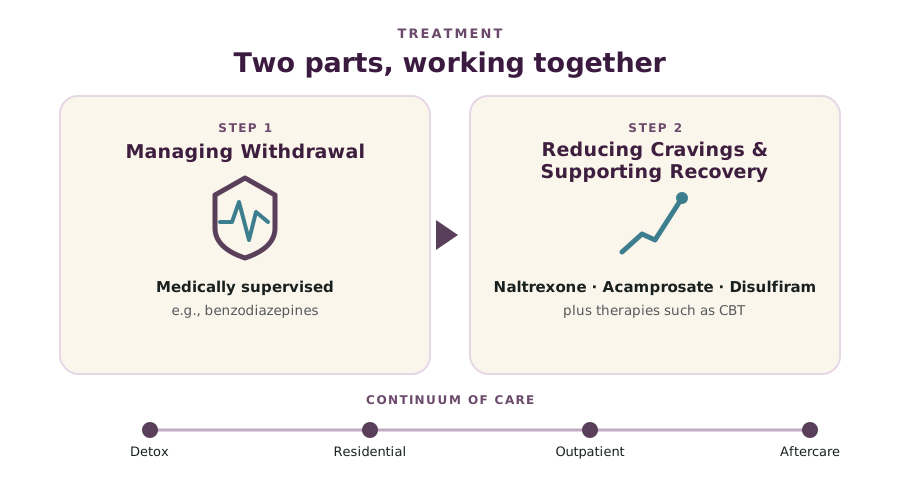
Treatment spans detox, residential, outpatient, and aftercare programs. Professional treatment significantly improves safety and long-term recovery outcomes, particularly for people with moderate to severe alcohol dependence.
Blackouts shouldn't leave anyone trying to recover in the dark. Treatment for alcohol addiction is available and can be life-changing.
Begin Healing at Regain Hope Detox, Burbank, California
If alcohol blackouts are becoming more frequent or are affecting your relationships, work, or safety, you do not have to face it alone. Recovery is possible, and treatment can begin today. Our physician-led team at Regain Hope Detox provides compassionate, evidence-based care to help you regain control of your health and your future.
Our medically supervised programs support you as you recover, providing a calm, alcohol-free space to heal. In our residential program, you stay at our center, receive evidence-based therapies and medication when appropriate, and rebuild a healthy sense of yourself.
All our treatment is tailored around you, factoring in your circumstances and medical history. Care is delivered by our certified, on-site clinicians, and we monitor you 24/7 to ensure your safety and progress.
We work with both individuals and couples, serving people in Burbank, Los Angeles County, and Southern California. Our care is available in English, Spanish, and Korean.
Hope is within reach. Regain yours today. Contact our admissions team.
FAQs
Can you blackout after only a few drinks?
Yes. Drinking quickly, drinking on an empty stomach, certain medications, body size, and genetics can all contribute — it's the speed at which blood alcohol rises that matters most, not just the total amount.
Do alcohol blackouts cause permanent brain damage?
Occasional blackouts usually do not, but repeated episodes — especially in the developing adolescent and young-adult brain — are associated with long-term problems with memory and thinking.
Is having one blackout a sign of alcoholism?
Not necessarily. However, repeated blackouts are an important warning sign and should be evaluated by a healthcare professional.
Can you recover memories from a blackout?
It depends on the type. With fragmentary blackouts, some memories can return when the person is reminded by others. With en bloc (complete) blackouts, the memories were generally never stored in the brain in the first place, so they usually cannot be recovered.
This article is intended for educational purposes only and should not replace personalized medical advice. If you believe you or someone else is experiencing alcohol poisoning or another medical emergency, call 911 immediately.
Sources
- National Institute on Alcohol Abuse and Alcoholism. (June 2025). Interrupted Memories: Alcohol-Induced Blackouts. niaaa.nih.gov.
- Lorkiewicz, S. et al. (October 2024). A longitudinal study of the relationship between alcohol-related blackouts and attenuated structural brain development. Developmental Cognitive Neuroscience.
- Spinetta, M. et al. (August 2008). Alcohol-induced retrograde memory impairment in rats: prevention by caffeine. Psychopharmacology.
- Carey, K. et al. (September 2022). Use of protective behavioral strategies and blackout experience among mandated college students. Addictive Behaviors.
- Sanchez, Z. et al. (August 2015). Binge Drinking Associations with Patrons' Risk Behaviors and Alcohol Effects after Leaving a Nightclub: Sex Differences in the "Balada com Ciência" Portal Survey Study in Brazil. PLOS One.
- Mundt, M. Zakletskaia, L. (April 2012). Prevention For College Students Who Suffer Alcohol-Induced Blackouts Could Deter High-Cost Emergency Department Visits. Health Affairs.
- Lindon-Carmichael, A. et al. (June 2023). Associations between blackout drinking and self-reported everyday cognition among young adults. Addictive Behaviors.
- Bae, H. et al. (May 2015). Patterns of Alcohol Consumption and Suicidal Behavior: Findings From the Fourth and Fifth Korea National Health and Nutritional Examination Survey (2007–2011). Journal of Preventive Medicine & Public Health.
- Prasad Neupane, S. Bramness, J. (July 2012). Prevalence and correlates of major depression among Nepalese patients in treatment for alcohol-use disorders. Drug and Alcohol Review.